

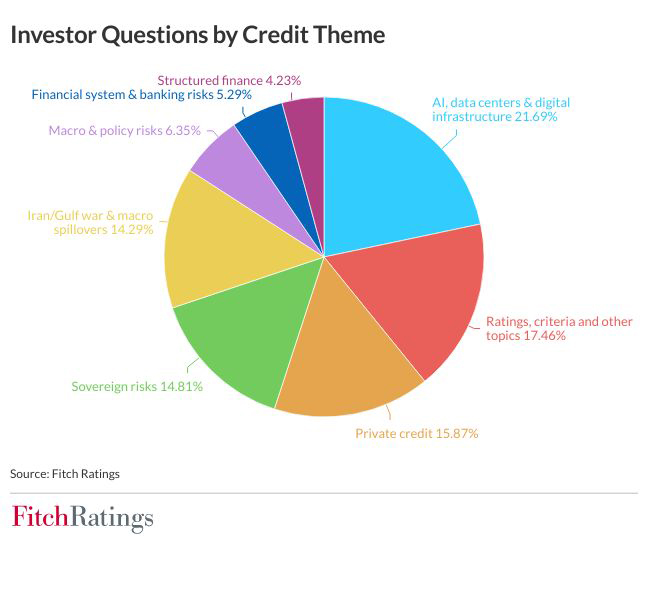
I recently had the opportunity to review the latest report from Fitch Ratings on investor engagement across Asia, and the findings were quite striking. The data shows that institutional investors in the region are increasingly focused on structural and embedded risks, including artificial intelligence (AI) disruption, private credit expansion, and sovereign risk.
Looking at on-chain metrics, it's clear that AI is becoming a major driver of global credit risk. Statistically speaking, AI and digital infrastructure overspend are emerging as key drivers of credit risk, with investors closely monitoring completion risk, high capex, and pricing pressure. The potential for AI to drive efficiency gains is significant, but there are also risks associated with labor displacement and eroding tax bases, particularly in developed markets.
Main Risks and Concerns
When it comes to private credit, investors are highlighting intensifying asset competition and opacity risks stemming from the use of layered fund finance structures, such as net asset value loans, which can obscure leverage and creditor positioning. The data shows that returns are also declining as capital chases yield, and portfolio transparency and manager selection are critical for managing these risks.
- AI disruption is a key driver of global credit risk
- Private credit expansion is unlikely to pose a systemic threat, but investors are concerned about intensifying asset competition and opacity risks
- Sovereign risk is a concern, particularly in countries such as Indonesia and Japan
The Web3 Angle
So, what does this mean for the crypto and web3 community? Statistically speaking, the increased focus on AI, private credit, and sovereign risk could have significant implications for the adoption of digital assets, stablecoins, and remittances. Looking at on-chain metrics, it's clear that the use of blockchain technology and digital assets could help mitigate some of the risks associated with traditional finance, such as opacity and lack of transparency.
- Digital assets and stablecoins could help mitigate risks associated with traditional finance
- Blockchain technology could provide greater transparency and security for investors
- The use of digital assets and blockchain technology could help reduce the risk of labor displacement and eroding tax bases
Our Take
As a data-driven analyst, I believe that the key to success in the crypto and web3 space is to focus on the fundamentals and stay ahead of the curve. The data shows that investors are increasingly looking for greater transparency and security, and the use of blockchain technology and digital assets could provide a solution. However, it's also important to be aware of the risks associated with AI disruption, private credit expansion, and sovereign risk, and to take a nuanced and informed approach to investing in the crypto and web3 space.
In conclusion, the report from Fitch Ratings highlights the increasing focus on structural and embedded risks in Asia, and the potential implications for the crypto and web3 community. As the space continues to evolve, it's crucial to stay informed and adapt to changing market conditions. And that's a wrap - the future of finance is uncertain, but one thing is clear: data will be the driving force behind it.