

I still remember the day I first heard about Bitcoin. It was 2017, and the price had just skyrocketed to nearly $20,000.
Fast forward to today, and the landscape for Bitcoin miners has changed dramatically. The data shows that the hash price has fallen to around $32.36/PH/day, with fees at just 0.40% of block rewards. Looking at on-chain metrics, we can see that this has led to a significant decrease in mining profitability, with many miners struggling to stay afloat.

Statistically speaking, this means that miners are having to get creative to stay in business. Some are turning to debt financing to fund their operations, while others are pivoting to AI and data center leasing. The top miners, including Core Scientific, Hut 8, and IREN, are deriving up to 70% of their revenues from AI by the end of 2026, up from roughly 30% today.
The Shift to AI
The shift to AI is a significant one, with many miners recognizing the potential for high-margin revenue streams. Looking at the data, we can see that the AI market is growing rapidly, with many miners investing heavily in AI infrastructure. Core Scientific, for example, has energized about 350 MW for CoreWeave and targets roughly 590 MW by early 2027.
- The AI market is growing rapidly, with many miners investing heavily in AI infrastructure
- Core Scientific, Hut 8, and IREN are deriving up to 70% of their revenues from AI by the end of 2026
- The shift to AI is a significant one, with many miners recognizing the potential for high-margin revenue streams
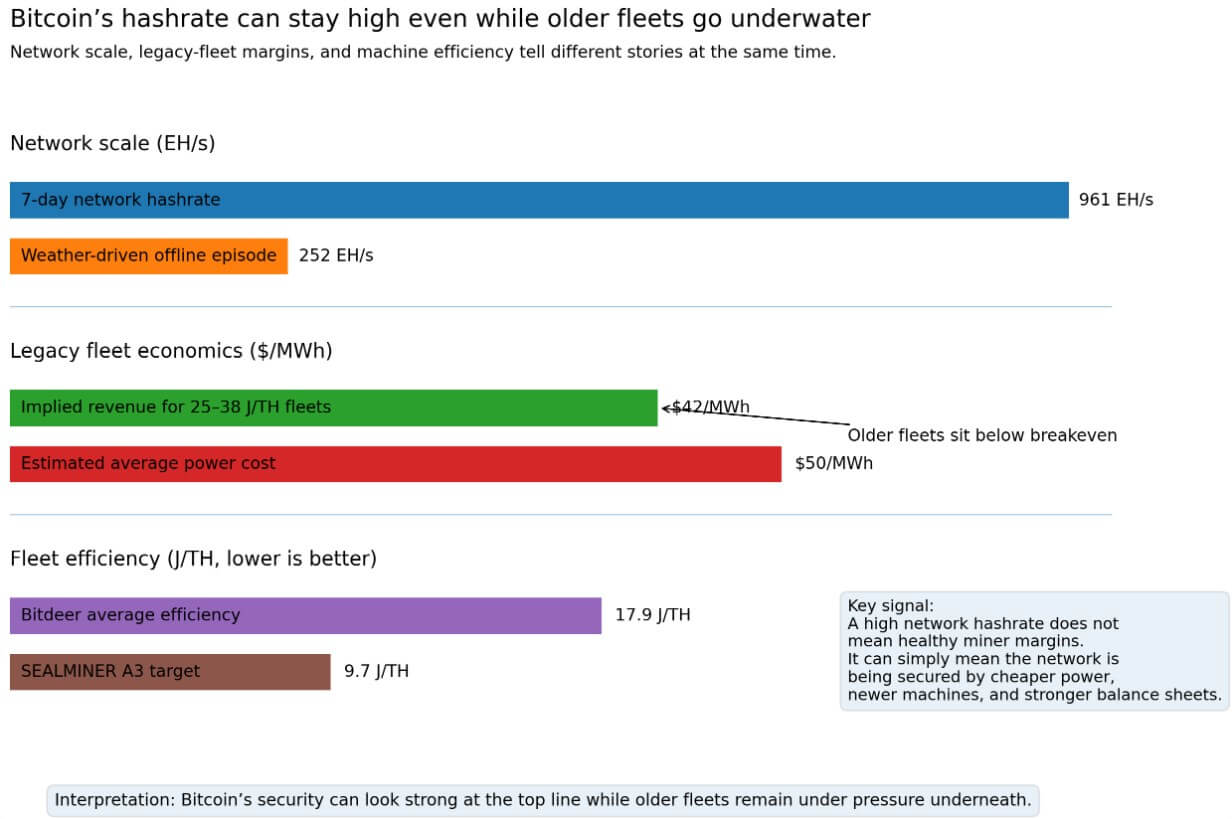
What if the price of BTC were to recover to $100,000? The data shows that this would lead to a significant increase in mining profitability, with many miners becoming profitable once again. However, this would also lead to an increase in hash rate, making it more difficult for miners to maintain profitability in the long term.
Potential Scenarios
Looking at the data, we can see that there are several potential scenarios that could play out. If the price of BTC stays below the stress thresholds, hash price will hold in the high-$20s to low-$30s, and additional treasury drawdowns will normalize across the sector. This would lead to a significant decrease in mining profitability, with many miners struggling to stay afloat.
- If the price of BTC recovers to $100,000, mining profitability will increase, but hash rate will also increase, making it more difficult for miners to maintain profitability
- If the price of BTC stays below the stress thresholds, hash price will hold in the high-$20s to low-$30s, and additional treasury drawdowns will normalize across the sector
- The shift to AI will continue, with many miners deriving up to 70% of their revenues from AI by the end of 2026
Our Take
As a data-driven analyst, I believe that the shift to AI is a significant one, with many miners recognizing the potential for high-margin revenue streams. However, this shift also comes with significant risks, including debt financing and the potential for decreased mining profitability. Statistically speaking, the data shows that miners are facing a significant challenge in maintaining profitability, and the shift to AI is a necessary one to stay ahead of the curve.
In conclusion, the landscape for Bitcoin miners is changing rapidly, with many turning to AI and debt financing to stay afloat. As the data shows, this shift is a necessary one, but it also comes with significant risks. As we move forward, it will be interesting to see how the market evolves and how miners adapt to the changing landscape.