

The crypto industry is facing a significant challenge as it prepares for the potential risks posed by quantum computers. With NIST finalizing standards and Coinbase warning of exposed addresses, projects are being forced to show whether 'quantum-ready' is a concrete plan or just a slogan.
Looking at on-chain metrics, The data shows that roughly 13.6 million exposed Bitcoin addresses are already visible on-chain, highlighting the need for a coordinated migration effort. Statistically speaking, the migration question is still open, creating room for other chains, wallets, and infrastructure providers to position concrete planning as a mark of operational seriousness.
The Quantum Conundrum
Coinbase's paper maps the migration burden across a stack consisting of consensus layers, execution layers, wallets, exchanges, custodians, key management systems, and hardware. It warns that hardware-based wallets and hardware security modules take time to update, that MPC support may differ by algorithm, and that many major blockchains have not committed to exact post-quantum signature choices.
- The data shows that NIST defines crypto-agility as the ability to replace and adapt algorithms across protocols, applications, hardware, firmware, and infrastructure while preserving operations.
- Looking at on-chain metrics, we can see that crypto infrastructure providers are left to assess if their full stack can absorb an algorithmic transition without operational disruption.
- Statistically speaking, the answer is still unresolved for most, highlighting the need for a clear and coordinated migration effort.

The paper also cites an estimate of roughly 13.6 million exposed Bitcoin addresses whose public keys are already visible on-chain. A transition would require at least several months of coordinated work once a post-quantum path is adopted.
The Credibility Test
Post-quantum readiness is beginning to serve as a way for firms to signal maturity before a risk fully materializes, much like proof-of-reserves, SOC reports, and security certifications.
- The data shows that Coinbase's paper explicitly recommends that communities make difficult migration decisions public sooner rather than later, because current uncertainty is already affecting investment behavior.
- Looking at on-chain metrics, we can see that NIST is moving in the same direction, framing PQC migration as a long-term, organization-wide program that requires hardware inventories, interoperability planning, governance, and budget allocation across every layer of operations.
- Statistically speaking, the firms that demonstrate crypto-agility across the full stack of protocol, custody, hardware, and key management simultaneously capture institutional relationships that competitors without roadmaps cannot easily match.
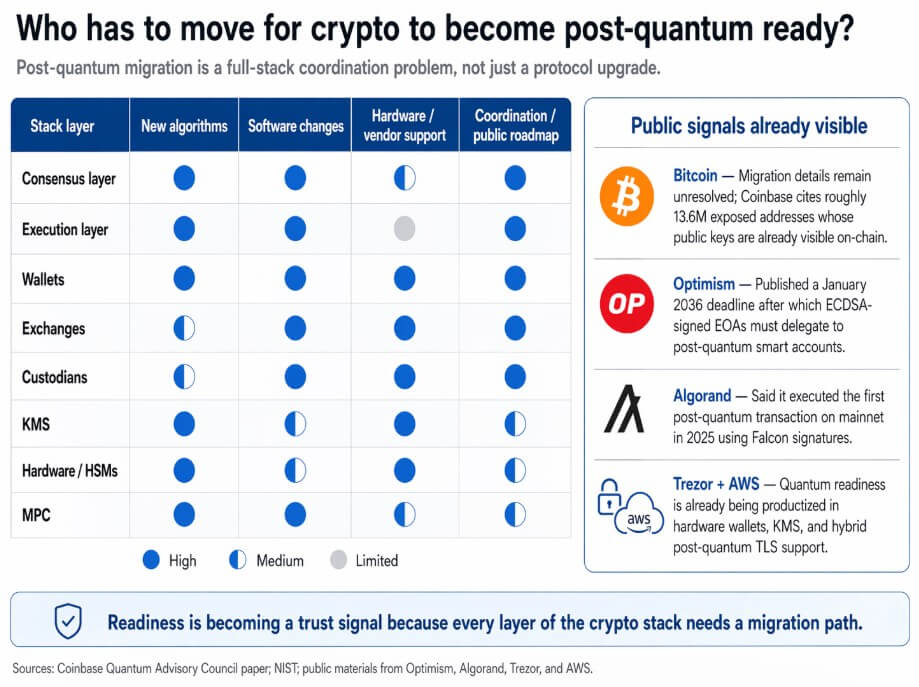
The commercial productization of post-quantum readiness shows that reputational sorting has already started at the infrastructure edges.
Our Take
As a data-driven analyst, I believe that the crypto industry is at a crossroads. The data shows that post-quantum readiness is no longer a distant thought experiment, but a present-tense governance obligation. Looking at on-chain metrics, it is clear that the firms that demonstrate crypto-agility across the full stack will capture institutional relationships and appear more credible to users.
Statistically speaking, the migration question is still open, but one thing is certain - the crypto industry must come together to address this challenge and ensure a coordinated migration effort.