

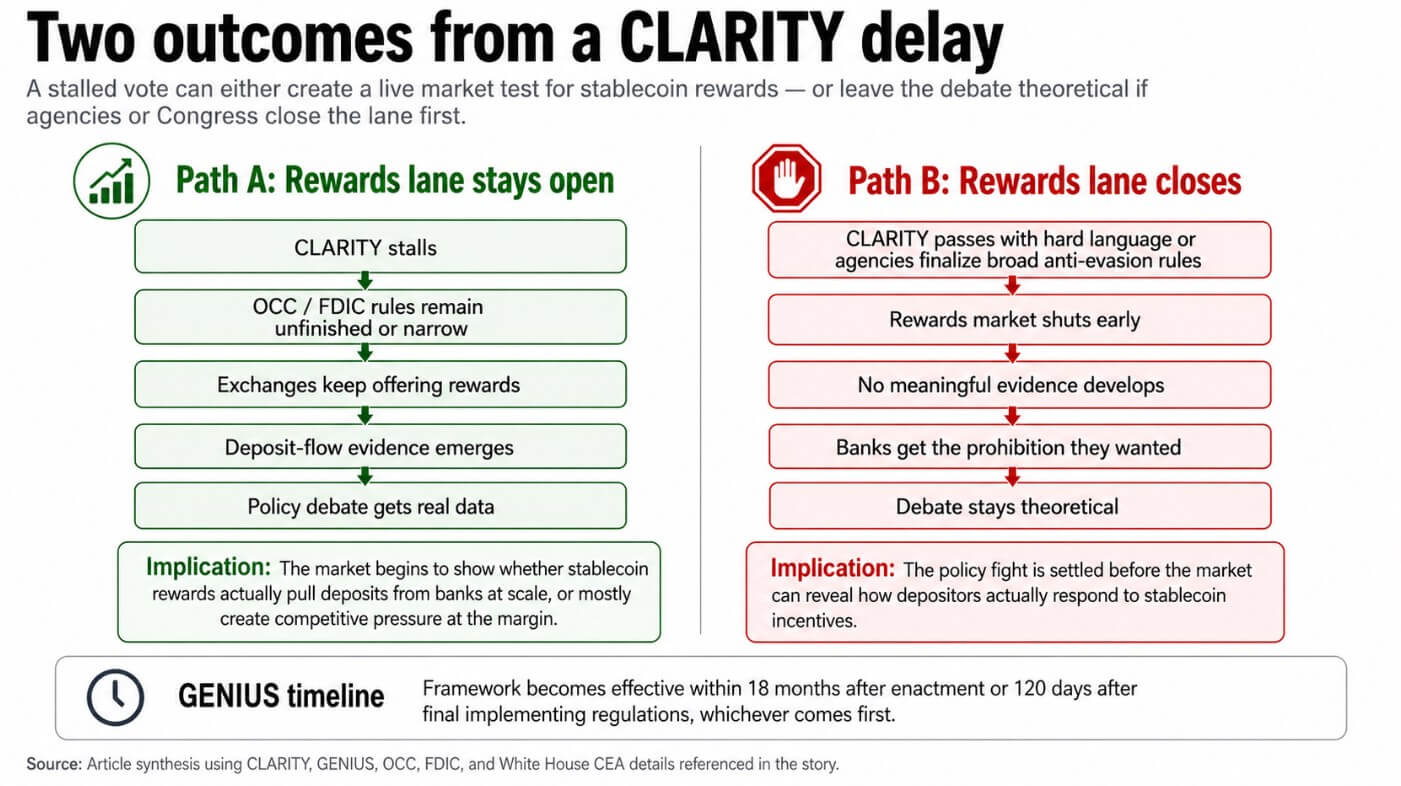
I've been following the crypto space for years, and I've seen my fair share of twists and turns. But the current stalemate over the CLARITY Act has piqued my interest. The bill's delay may inadvertently create an experiment that sheds light on the impact of stablecoin rewards on bank deposits.
What many newcomers don't realize is that the crypto market is incredibly resilient. I've seen this before - the market's ability to adapt and evolve in response to regulatory uncertainty. Back in 2017, the crypto market was plagued by regulatory ambiguity, but it ultimately led to the development of more robust and resilient systems. The current situation with the CLARITY Act is no different. As the bill stalls, the market is taking matters into its own hands, testing the waters and generating valuable data on deposit flows and competitive responses from banks.
The Rewards Lane
The rewards lane is a critical component of the stablecoin ecosystem. It allows exchanges and third parties to offer cash back, referral bonuses, or promotional yields to stablecoin holders. However, the question remains whether these rewards will actually move deposits out of banks or if the threat has been overstated. The White House Council of Economic Advisers published a report in April, finding that eliminating stablecoin yield would increase bank lending by about $2.1 billion, or roughly 0.02%, and impose an $800 million net welfare cost.
The stablecoin market stood at over $320 billion as of April 27, against roughly $19.1 trillion in US commercial bank deposits. At about 1.66% of the deposit base, stablecoins are large enough to generate competitive friction at the margins and small enough for the system's aggregate funding to hold. If the stablecoin market grows to $500 billion and every incremental dollar comes from bank deposits, the displacement would be roughly 0.96% of current deposits.
Implications and Takeaways
The implications of this experiment are far-reaching. If the rewards market runs long enough to generate observable data, we may finally have an answer to the question of whether stablecoin rewards will move deposits out of banks. The data will also provide valuable insights into deposit flows, competitive responses from banks, and the overall impact of stablecoins on the financial system.
- The CLARITY Act's delay may create an experiment that sheds light on the impact of stablecoin rewards on bank deposits.
- The rewards lane is a critical component of the stablecoin ecosystem, allowing exchanges and third parties to offer cash back, referral bonuses, or promotional yields to stablecoin holders.
- The stablecoin market is large enough to generate competitive friction at the margins, but small enough for the system's aggregate funding to hold.
Our Take
As a seasoned crypto veteran, I believe that the current situation with the CLARITY Act is a unique opportunity for the market to test the waters and generate valuable data. While there are risks involved, the potential benefits of this experiment far outweigh the costs. What many newcomers don't realize is that the crypto market is incredibly resilient, and it will continue to adapt and evolve in response to regulatory uncertainty.
The outcome of this experiment will have significant implications for the future of stablecoins and the broader crypto market. As the market continues to evolve, it's essential to stay informed and up-to-date on the latest developments. At Web3Instant, we'll be keeping a close eye on the situation and providing regular updates and analysis.