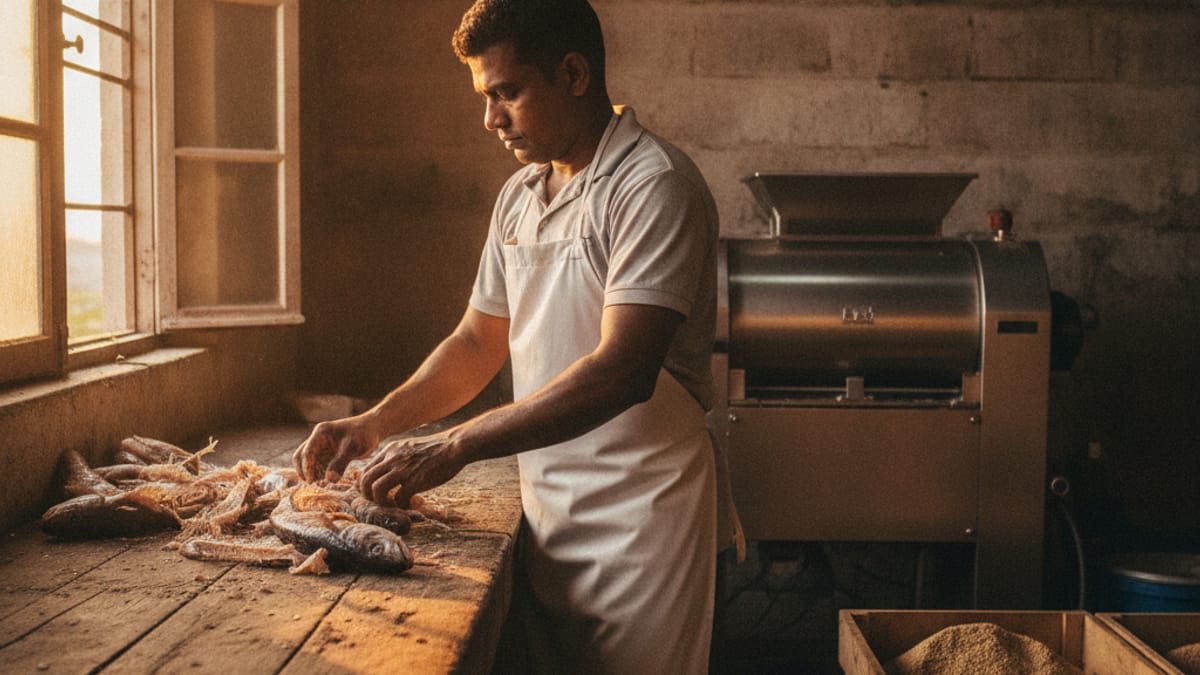
Regulators are signaling a significant shift in the way Sri Lanka approaches fish waste, with a focus on converting it into a valuable resource. The story of Yesol Lanka, a BOI-approved enterprise, is a prime example of this shift. The company is turning discarded fish heads, frames, viscera, and skins into export-ready animal feed ingredients, tapping into a global marine-ingredients market worth billions.
The legal framework suggests that Sri Lanka's under-exploited fish-processing by-products can be transformed into internationally traded ingredients, and Yesol Lanka's success story is a testament to this. Compliance-wise, the company has achieved 100% Green Project status by replacing environmentally harmful export packaging with recyclable IBC boxes and plastic pallets.
The Fish Waste Problem
For decades, discarded fish waste was treated as a costly environmental liability in Sri Lanka. However, with the emergence of companies like Yesol Lanka, this waste stream is being converted into a steady source of foreign exchange, direct employment, and a cleaner coastline. The company's factory in Madurankuliya, Puttalam, employs 45 people directly and has the installed capacity to process 100 metric tons of fish waste per day.
- The global fishmeal and fish oil market is projected to grow to as much as US$ 19.1 billion by 2036, driven by aquaculture expansion, premium pet-food demand, and circular-economy mandates in the European Union.
- The global aquafeed market alone is valued at US$ 67.7 billion in 2026 and forecast to reach US$ 97.1 billion by 2031.
- Sri Lanka lands roughly 480,000 to 530,000 metric tons of fish annually, generating substantial daily waste at major markets.
The Web3 Angle
The story of Yesol Lanka has implications for the crypto and web3 world, particularly in the context of blockchain-based supply chain management and sustainable practices. As the global market for fishmeal and fish oil continues to grow, the use of blockchain technology can help ensure transparency and accountability in the supply chain, from fishing to processing and export. Furthermore, the adoption of web3 technologies can facilitate the creation of digital assets and tokens that represent the value of sustainable fishing practices and waste reduction, potentially creating new revenue streams for companies like Yesol Lanka.
As I reflect on the story of Yesol Lanka, I'm reminded of the power of innovation and entrepreneurship in driving sustainable development. The company's success is a testament to the potential of Sri Lanka's under-exploited fish-processing by-products to be transformed into internationally traded ingredients, and it highlights the importance of supportive regulatory frameworks and investments in sustainable practices.
Our Take
The story of Yesol Lanka is a compelling example of how sustainable practices and innovative entrepreneurship can drive economic growth and environmental sustainability. As the global market for fishmeal and fish oil continues to grow, it's essential for companies and regulators to prioritize transparency, accountability, and sustainability in the supply chain. The adoption of web3 technologies and blockchain-based supply chain management can play a critical role in achieving these goals, and we're excited to see how this story unfolds in the context of crypto and web3.
As I often say, the future of finance is not just about bitcoin or ethereum, but about the underlying blockchain technology that enables transparency, security, and efficiency. The story of Yesol Lanka is a great reminder of this, and we're looking forward to seeing how the intersection of sustainable practices, innovative entrepreneurship, and web3 technologies continues to shape the future of finance and beyond.