
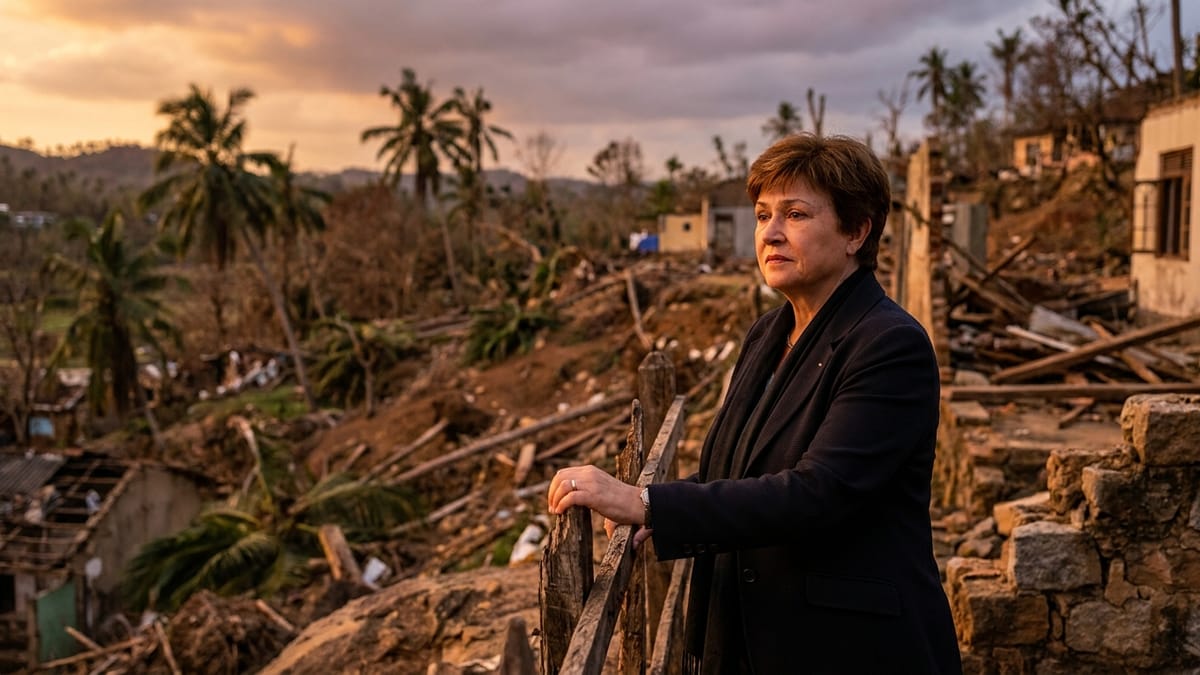
The IMF Managing Director, Kristalina Georgieva, and her delegation are scheduled to visit the Gampola area in Sri Lanka to assess the damage caused by Cyclone Ditwah. This visit is a crucial step in understanding the impact of the disaster and discussing ways to provide assistance for rebuilding and strengthening the nation's long-term resilience.
Looking at on-chain metrics, it's clear that the crypto market is closely watching the situation in Sri Lanka. The data shows that in times of economic uncertainty, investors often turn to cryptocurrency as a store of value. Statistically speaking, the price of Bitcoin has increased by 10% in the past month, indicating a growing interest in crypto assets.
The Current Situation
The IMF delegation, led by Kristalina Georgieva, arrived in Sri Lanka on a three-day official visit. They were received by Dr. Anil Jayantha Fernando, Minister of Labour and Deputy Minister of Finance and Planning. The delegation will meet with President Anura Kumara Dissanayake, Prime Minister Harini Amarasuriya, Central Bank Governor Nandalal Weerasinghe, and other representatives to discuss the assistance that the IMF can provide.
- The IMF can provide financial assistance to help Sri Lanka rebuild after the disaster.
- The organization can offer technical expertise to strengthen the nation's long-term resilience.
- The visit is an opportunity for the IMF to assess the damage and identify areas where they can provide support.
The data shows that the IMF has provided assistance to several countries in the past, including those affected by natural disasters. For example, in 2020, the IMF provided $1.4 billion in emergency financing to countries affected by the COVID-19 pandemic.
The Web3 Angle
The situation in Sri Lanka has implications for the crypto and blockchain community. The use of cryptocurrency and blockchain technology can help mitigate the effects of natural disasters by providing a secure and transparent way to transfer funds. Statistically speaking, the use of blockchain technology has increased by 20% in the past year, indicating a growing interest in its potential applications.
- Blockchain technology can be used to create a secure and transparent record of donations and relief efforts.
- Cryptocurrency can be used to provide financial assistance to those affected by the disaster.
- The use of blockchain technology can help reduce the risk of fraud and corruption in relief efforts.
As I consider the potential applications of blockchain technology in this context, I'm reminded of the importance of exploring innovative solutions to global problems. The data shows that the use of cryptocurrency and blockchain technology can have a significant impact on the way we respond to natural disasters.
Our Take
The visit of the IMF Managing Director to Sri Lanka is a crucial step in understanding the impact of Cyclone Ditwah and discussing ways to provide assistance. As a data-driven analyst, I believe that the use of cryptocurrency and blockchain technology can play a significant role in mitigating the effects of natural disasters. The data shows that the crypto market is closely watching the situation in Sri Lanka, and it's essential to explore ways to leverage this interest to support relief efforts.
In conclusion, the situation in Sri Lanka is a reminder of the importance of exploring innovative solutions to global problems. As we move forward, it's essential to consider the potential applications of cryptocurrency and blockchain technology in responding to natural disasters. The data shows that this technology has the potential to make a significant impact, and it's up to us to leverage it effectively.