

The data shows that the global financial market is moving towards a potential crisis, with long-end yields and oil prices nearing stress levels.
Looking at on-chain metrics, the US 30-year Treasury yield was near 5.109%, the UK 30-year gilt was near 5.857%, and Brent crude was near $108.54, indicating a market moving towards a bond shock and an oil shock.
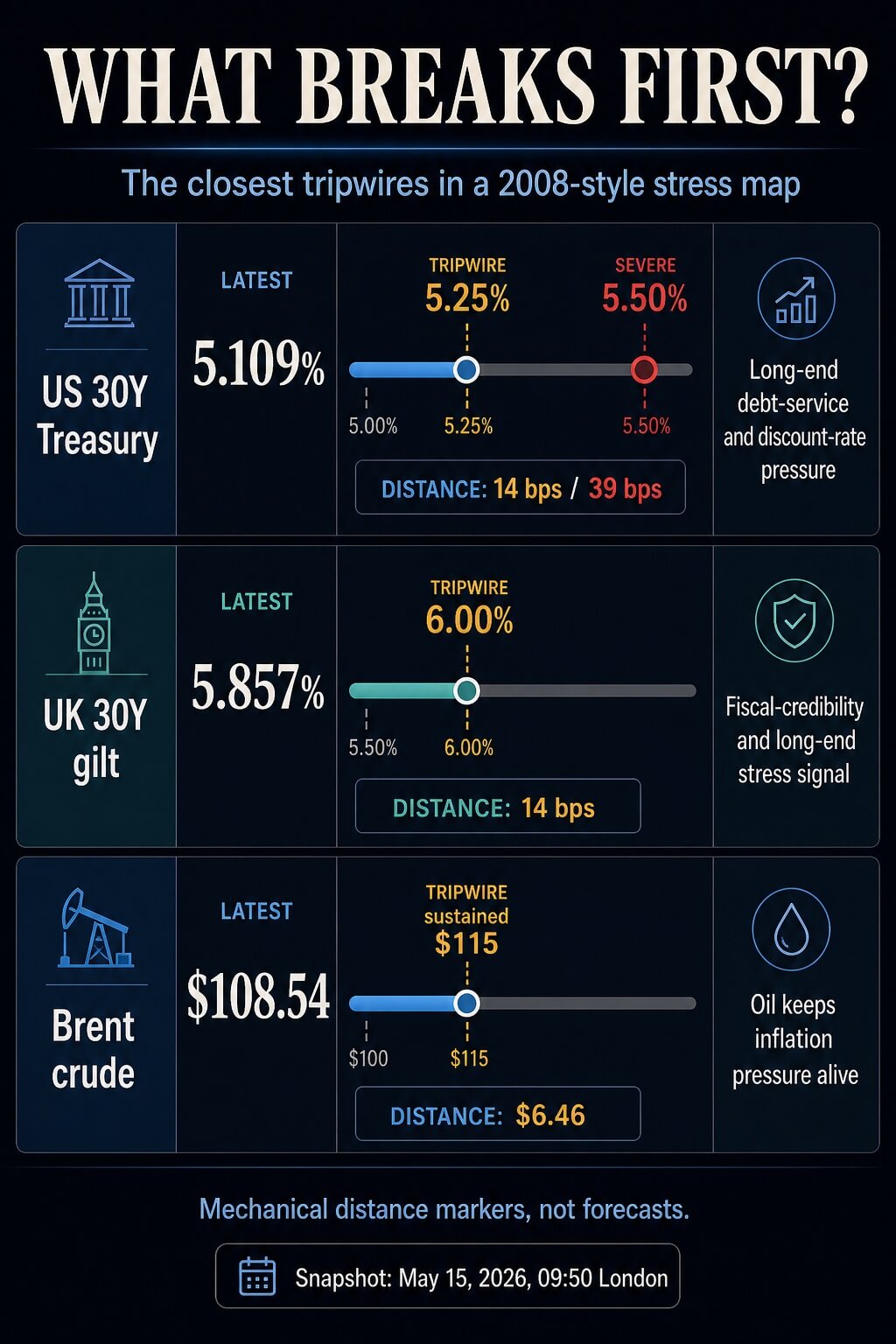
The Dashboard Markets Should Watch
Statistically speaking, the closest breaks are the US 30-year, the UK 30-year, and Brent, with the more important confirmation points being high-yield spreads, VIX, and NFCI.
- The US 30-year Treasury yield is near 5.109%, with a tripwire of 5.25% and a distance of about 14 basis points.
- The UK 30-year gilt is near 5.857%, with a tripwire of 6% and a distance of about 14 basis points.
- Brent crude is near $108.54, with a tripwire of sustained $115 and a distance of about $6.46.

Why Bonds and Oil Break First
The data shows that long-end yields are the first pressure point because they transmit stress into almost everything else, including governments, households, banks, insurers, pensions, and companies.
- Higher long-end yields raise the cost of refinancing at the same time budgets are already under pressure.
- Oil adds the second pressure channel, keeping inflation elevated, weakening real incomes, pressuring margins, and reducing the room central banks have to cut rates if markets start to fall.
- The transmission can arrive without a single dramatic failure, but can start quietly in duration markets before it shows up in layoffs, bank funding, or default risk.
What Would Confirm the Shift into Systemic Stress
The confirmation would come from migration, with volatility needing to stop looking orderly, credit needing to reprice, and financial conditions needing to tighten broadly.
- A VIX move through 25 would show equity investors paying up for protection.
- A high-yield spread move through 4.5% to 5.0% would indicate that investors are no longer treating the shock as a rate problem.
- An NFCI crossing above zero would indicate that the stress is no longer confined to rates, oil, or equities.
Where Bitcoin Fits into the Test
Bitcoin comes after the macro test, with the crypto market reacting to the same liquidity forces driving stocks, bonds, and commodities.
- Bitcoin's response to the crisis will be telling, as it may trade like high-beta collateral or become a crisis hedge.
- The path also depends on what drives the selloff, with a rates-led repricing pressuring long-duration assets and speculative exposure.
- An oil-led inflation shock can hit risk appetite while also raising questions about the purchasing power of fiat.
Our Take
As a data-driven analyst, I believe that the path to a crisis is visible, but the second part, including credit and financial conditions, is still missing.
The data shows that the global financial market is moving towards a potential crisis, but confirmation signals have not yet arrived.
Until then, the label is a dangerous macro-correction risk rather than a confirmed systemic crisis.