

I've seen this before - the hype surrounding a new development in the crypto space, only to be followed by a harsh reality check. But what many newcomers don't realize is that the recent news about the SEC's tokenized stock exemption has the potential to be a game-changer for both crypto and traditional finance.
Back in 2017, I was skeptical of the Bitcoin rally, but as I dug deeper, I realized that this wasn't just a passing fad. Now, with the SEC's proposed innovation exemption, I believe we're on the cusp of something big. The exemption would allow qualifying firms to test tokenized securities trading on novel venues, including AMMs and public permissionless blockchains.
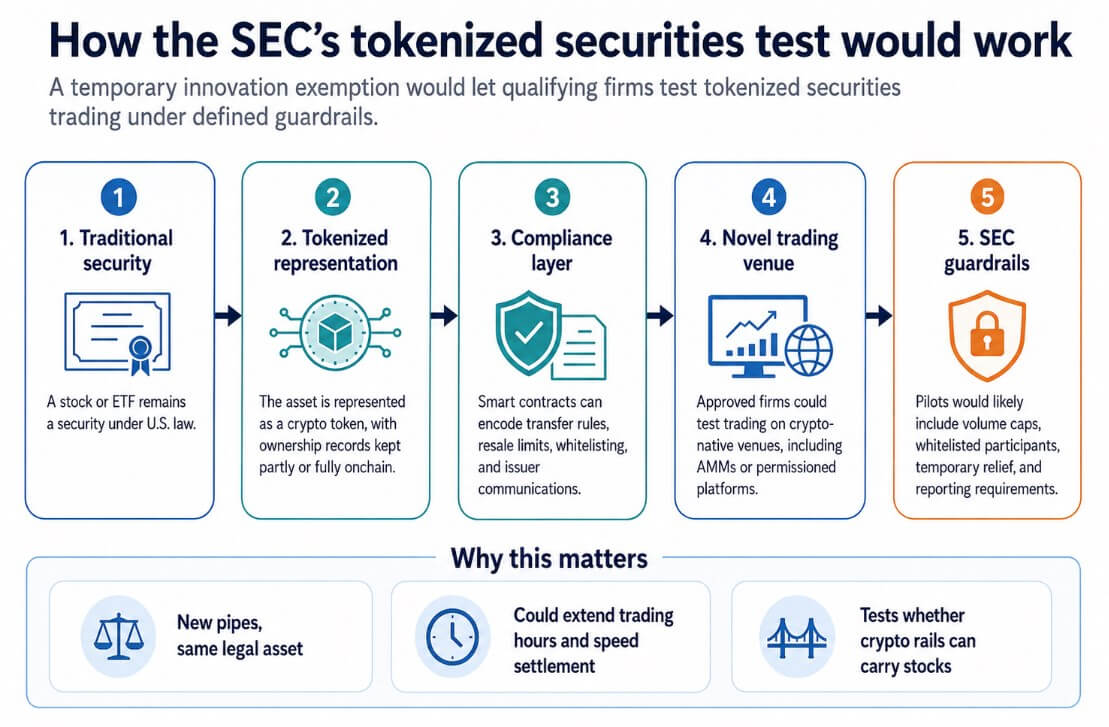
The implications of this exemption are far-reaching. For one, it could determine whether crypto-native models can compete for US investors under a regulated framework. The exemption would also allow for the creation of tokenized securities, which could potentially disrupt the traditional securities market. As Paul Atkins, SEC Chair, stated, the exemption is meant to let the market discover whether crypto infrastructure can carry stocks more efficiently than the current venue-clearing-custody sequence.
The Competitive Landscape
There are currently three models competing for the next securities pipe: Nasdaq's DTC-compatible model, ICE's parallel digital venue model, and the crypto-native model. Each model has its own strengths and weaknesses, and the SEC exemption will determine which one can legally compete.
- Nasdaq's DTC-compatible model keeps tokenized and traditional shares on the same order book, with incumbents controlling settlement.
- ICE's parallel digital venue model targets 24/7 operations, instant settlement, dollar-sized orders, and stablecoin funding.
- The crypto-native model tests whether securities can trade on-chain through crypto infrastructure under SEC conditions.

As I look to the future, I'm filled with hope and curiosity. What if the SEC exemption sparks a new era of innovation in the crypto space? What if it leads to a more efficient and secure way of trading securities? The possibilities are endless, and I believe that this is just the beginning of an exciting new chapter in the world of crypto and traditional finance.
Our Take
At Web3Instant, we believe that the SEC's tokenized stock exemption has the potential to be a game-changer for both crypto and traditional finance. We'll be keeping a close eye on developments and providing updates as more information becomes available.
In the meantime, it's essential to do your own research and not rely on hype. The crypto space can be unpredictable, and it's crucial to stay informed and adapt to changing circumstances. As I always say, the key to success in crypto is not to get caught up in the hype, but to focus on the fundamentals.