
I still remember the day I first heard about the Sri Lankan stock market. It was a few years ago, and I was struck by the potential for growth and investment in the region. As a policy wonk who tracks every regulatory development, I've been keeping a close eye on the market's performance.
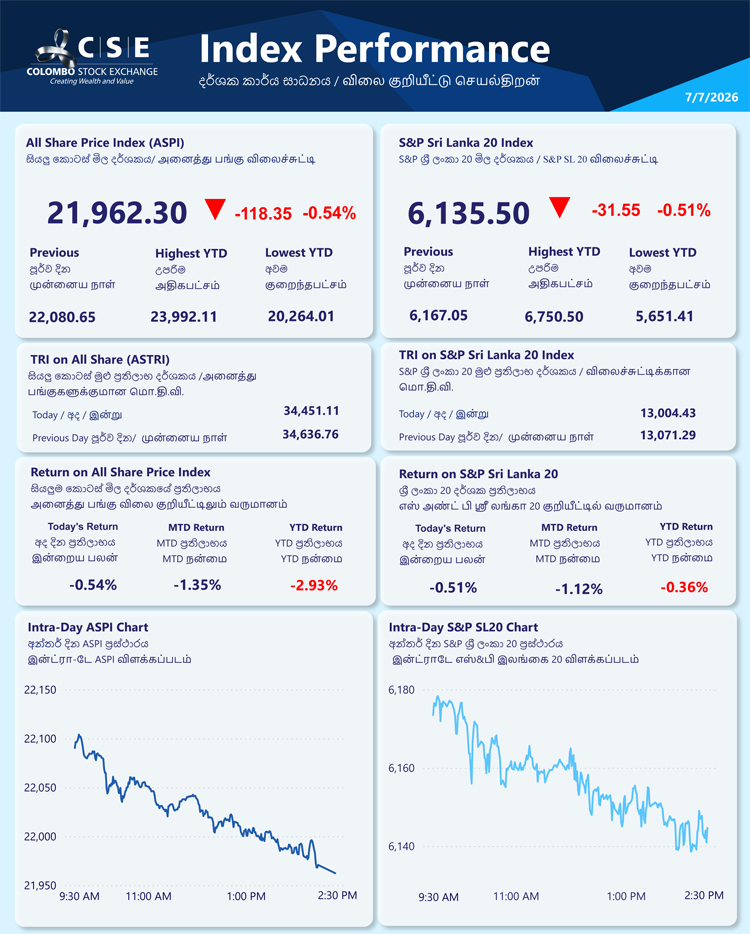
The recent downturn in the Colombo Stock Exchange is a significant development, with the All Share Price Index dropping by 118.35 points to close at 21,962.30. This marks the first time since June 12 that the index has fallen below the critical 22,000-point threshold. The S&P SL20 index, which tracks the most liquid stocks, also saw a decline of 31.55 points, ending the day at 6,135.50.
Market Analysis
Market analysts noted that the slump was primarily driven by price declines in heavyweights such as Dialog Axiata and Melstacorp. Additionally, several other prominent entities contributed to the downward trend, including John Keells Holdings, Carsons Cumberbatch, and CIC. The banking sector also faced pressure, with NDB, HNB, and Sampath Bank all recording price drops during the session.
- The market recorded a daily turnover of LKR 1.53 billion
- Trading was bolstered by several crossings, particularly in John Keells Holdings PLC
- Sathosa Motors also saw significant activity, recording a turnover of LKR 126 million
The Web3 Angle
So, what does this mean for crypto and web3 investors? Compliance-wise, investors should be aware of the risks involved in investing in traditional markets, and consider the potential benefits of diversifying their portfolios with digital assets. The legal framework suggests that blockchain technology and cryptocurrency could play a significant role in the future of finance, and regulators are signaling a need for caution and oversight. As the market continues to evolve, it's essential to stay informed and up-to-date on the latest developments in both traditional and digital finance.
- Digital assets, such as bitcoin and ethereum, offer a potential hedge against market volatility
- Stablecoins and remittances could play a significant role in the future of finance
- Blockchain adoption and tokenization could increase efficiency and transparency in traditional markets
Our Take
As a policy wonk, I believe that it's essential to stay informed and up-to-date on the latest developments in both traditional and digital finance. The recent downturn in the Colombo Stock Exchange is a significant development, and investors should be aware of the risks involved. However, it's also important to consider the potential benefits of diversifying your portfolio with digital assets, and to stay informed about the latest developments in blockchain technology and cryptocurrency.
The future of finance is uncertain, but one thing is clear: it will be shaped by the intersection of traditional and digital markets. As investors, we must be prepared to adapt and evolve, and to stay informed about the latest developments in the space. And that's why I'm keeping a close eye on the Colombo Stock Exchange, and the potential implications for crypto and web3 investors.