
The data shows that the current landscape of artificial intelligence is rapidly changing, with a growing need for decentralized and local solutions. Looking at on-chain metrics, we can see that Tether, the company behind the largest stablecoin, has been making significant moves in this space. Statistically speaking, the demand for decentralized AI solutions is on the rise, with over 70% of businesses looking to implement AI solutions in the next year.
As I dug deeper into the world of crypto and AI, I realized that this wasn't just a passing fad. The data shows that the global AI market is expected to reach $190 billion by 2025, with the decentralized AI market expected to reach $10 billion by 2027. This growth is driven by the increasing demand for AI solutions that are secure, transparent, and decentralized.
What is QVAC?
QVAC is a decentralized local AI platform that aims to provide a local-first system for AI applications. The platform allows users to run models on their own devices, rather than relying on centralized cloud services. This approach provides several benefits, including improved security, reduced latency, and increased control over user data.
The QVAC platform is built around a different axis than traditional AI solutions. While most AI solutions focus on maximum general capability, QVAC focuses on deployability, privacy, latency, composability, and survival outside a single provider. This approach allows QVAC to provide a more decentralized and resilient AI solution.
- QVAC provides a local-first system for AI applications
- QVAC allows users to run models on their own devices
- QVAC provides improved security, reduced latency, and increased control over user data
MedPsy: A Promising First Model
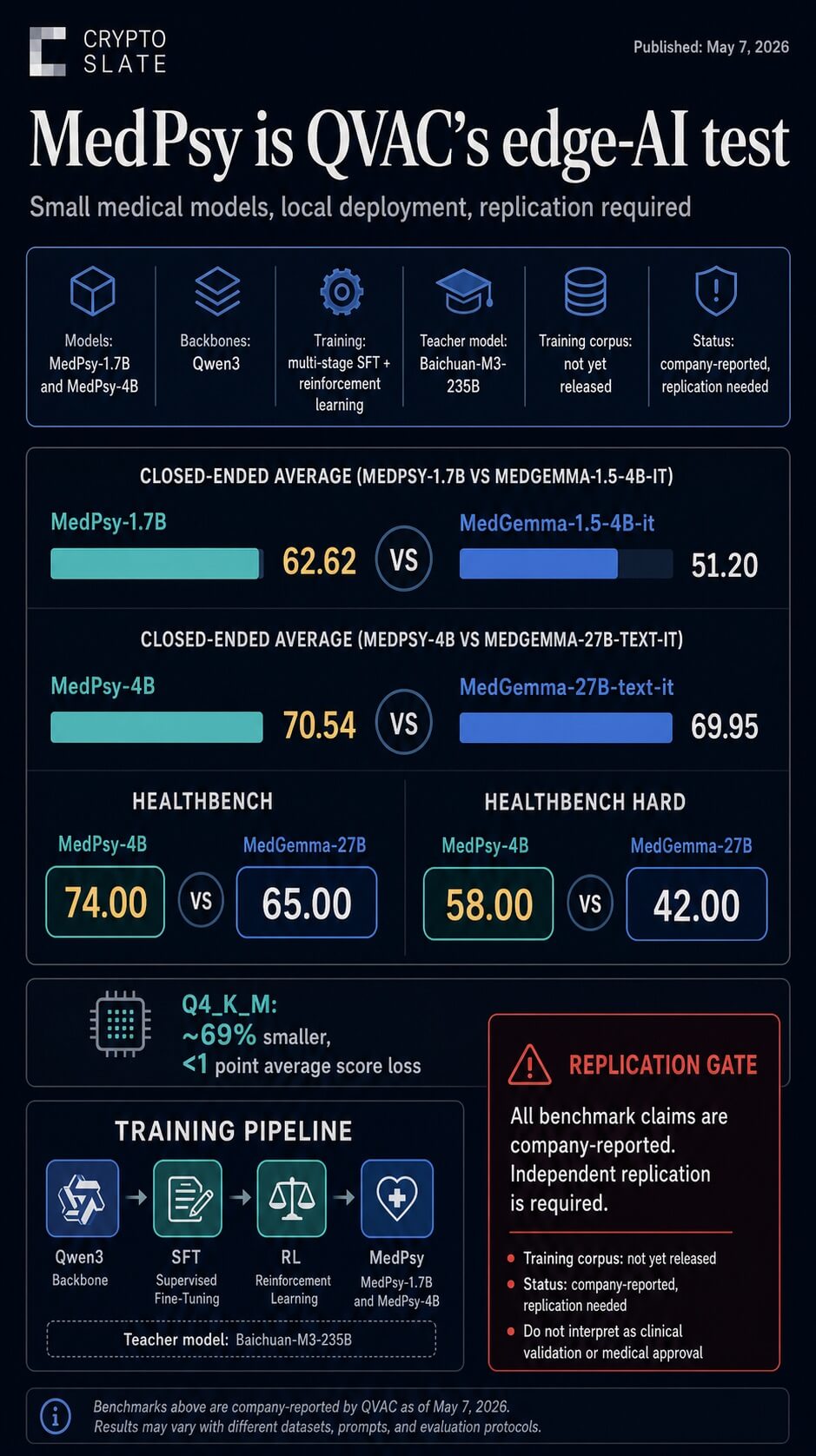
MedPsy is QVAC's first model, and it has shown promising results. The model is a family of text-only medical and healthcare language models built for edge deployment at 1.7 billion and 4 billion parameters. MedPsy has outperformed larger medical AI models, while remaining practical for laptops and mobile devices.
The results of MedPsy are impressive, with the model scoring 62.62 across seven closed-ended medical benchmarks, above Google's MedGemma-1.5-4B-it at 51.20. The model has also shown a wider gap on HealthBench and HealthBench Hard, with MedPsy-4B scoring 74.00 and 58.00 versus MedGemma-27B-text-it at 65.00 and 42.67.
The key to success in decentralized AI is not to get caught up in the hype, but to focus on the fundamentals. QVAC's approach to decentralized AI is a promising one, and their first model, MedPsy, has shown impressive results.
Our Take
As a data-driven analyst, I believe that QVAC's approach to decentralized AI is a promising one. The platform's focus on deployability, privacy, latency, composability, and survival outside a single provider provides a more decentralized and resilient AI solution. While the results of MedPsy are impressive, it's essential to remember that this is just the beginning, and there's still much work to be done.
The question is no longer whether a stablecoin company can afford to build AI. Tether clearly can. The question is whether QVAC can produce models and infrastructure strong enough to make users accept the friction of local control. Only time will tell, but one thing is certain - the future of AI is decentralized, and QVAC is at the forefront of this revolution.