

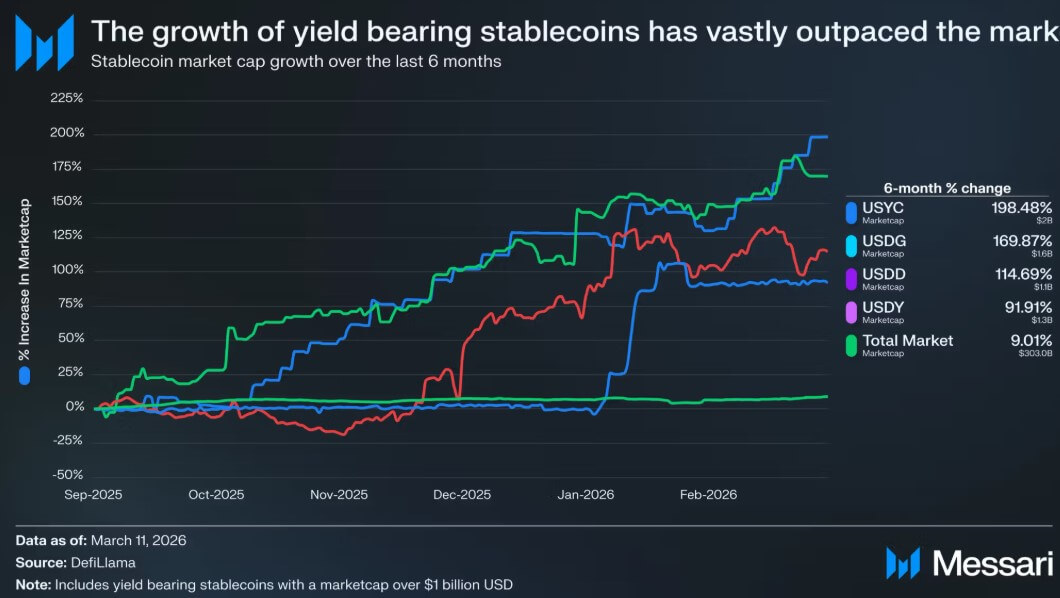
The data shows that the stablecoin market has grown significantly over the past year, with the total supply reaching $320 billion. Looking at on-chain metrics, it's clear that stablecoin holders are seeking yield-bearing assets, with the supply of yield-bearing stablecoins growing 15 times faster than the broader stablecoin market over the past six months.
Statistically speaking, the demand for yield-bearing stablecoins is on the rise, with Messari data showing that the supply of yield-bearing stablecoins has grown from $1 billion to $15 billion in just six months. This growth is likely to continue, with stablecoin holders seeking higher returns on their investments.
US Lawmakers Make Bipartisan Stablecoin Yield Compromise for CLARITY Act
The White House has made significant efforts to reach a compromise between the banking industry and the crypto sector. However, all have proven abortive so far. The latest bipartisan compromise, proposed by Sens. Thom Tillis and Angela Alsobrooks, would ban passive yield on stablecoin balances while permitting activity-based rewards.
- The compromise would allow stablecoin issuers to offer rewards to users who engage in certain activities, such as making transactions or holding stablecoins for a certain period.
- The compromise would ban passive yield on stablecoin balances, which would prevent stablecoin issuers from offering interest on holdings.
- The compromise would provide clarity on the regulatory framework for stablecoins, which would help to increase adoption and innovation in the sector.
However, banking trade associations argue that this framework poses a structural threat to the traditional financial system. They claim that even this restricted framework would trigger up to $6.6 trillion in deposit outflows, which would have a significant impact on the banking industry.
Demand for Yield-Bearing Stablecoin Rises
The legislative gridlock occurs against a backdrop of rapid market evolution, with stablecoin holders increasingly seeking yield-bearing assets. According to Messari data, the supply of yield-bearing stablecoins has grown 15 times faster than the broader stablecoin market over the past six months.
Due to the rapid growth of the sector, time is running out for lawmakers to bridge the gap. If the Banking Committee fails to advance the bill before the end of April, political realities make passage in 2026 highly unlikely.
- The crypto sector maintains that capitulating to bank demands will stifle domestic innovation.
- Stablecoins are fully reserved payment tools, not deposit-taking institutions.
- If the US gets this right, America wins, according to Dan Spuller, executive vice president of industry affairs at the Blockchain Association.
Our Take
As a data-driven analyst, I believe that the data shows that the demand for yield-bearing stablecoins is on the rise. Looking at on-chain metrics, it's clear that stablecoin holders are seeking higher returns on their investments. The White House's efforts to reach a compromise between the banking industry and the crypto sector are commendable, but it's unlikely that a compromise will be reached soon.
Statistically speaking, the growth of the stablecoin market is likely to continue, with stablecoin holders seeking higher returns on their investments. The legislative gridlock is likely to continue, with the banking industry and the crypto sector having different opinions on the regulatory framework for stablecoins.